Interpretation of Organic Acid Testing In The Setting of Suspected Sulfite Toxicity

Alterations in organic acid testing results can be interpreted in many ways. Here is a sulfite focused interpretation of changes in organic acid testing.

*****THIS IS NOT MEDICAL ADVICE – PLEASE CONSULT WITH YOUR PROVIDER BEFORE MAKING ANY CHANGES*****

Marker#59 2-hydroxybutyric acid is typically thought to be from increased CBS activity to produce more glutathione. However, this could be the product of a block at BKCDH as the alpha-ketobutyrate is metabolized to propionyl CoA via the enzyme branched chain keto acid dehydrogenase (needs B1, CoA, lipoate, FAD, NAD – of which sulfite toxicity destroys all of these).  Alpha ketobutyrate will then be forced to produce 2-hydroxybutyric acid. In sulfite toxicity due to SUOX deficiency, it has been shown that CBS activity is negligible. Most of the H2S is coming from 3-MST. https://pmc.ncbi.nlm.nih.gov/articles/PMC7711302/pdf/main.pdf   Another possibility is a competition between BCKA and alpha ketobutyrurate for BCKDH due to the catabolism of BCAA to restore TCA cycle metabolism through succinyl CoA repletion. This has been shown to occur in this study. In theory, this would lead to increased propionyl CoA levels, competition for PCC, and possibly a build-up of butyryl CoA (see Marker #45 below). 

Marker#24 Succinate could be FAD deficiency, itaconate (but will have high #30 3-methylglutaric acid as well if itaconate), but could also be inhibition of succinate dehydrogenase by free sulfite. Normal succinate doesn’t mean you are not having a sulfite issue. It could be that you are deficient in B12 (mopping up sulfite), preventing the flux of methylmalonyl CoA to succinyl CoA.

Marker #50 Methymalonic Acid. This marker is associated with vitamin B12 deficiency. However, if you have a deficiency in a cofactor at BCKDH (B1, CoA, lipoate, FAD, NAD), then you won’t have enough methylmalonyl CoA to show up B12 deficient. In addition, you could have competition for MUT by ethylmalonyl CoA if ACADS is inhibited by CoASSH (from glutathione deficiency, which  causes CoASH to be used for the cofactor for SQR)

Marker #45 Ethylmalonic Acid. This could be high due to excess H2S, a known inhibitor of ACAD (SCAD), but we should not have excess butyrate in our general circulation. This may indicate a leaky gut. It can also mean that ACADS is being inhibited by CoASSH because of SEVERE GLUTATHIONE deficiency.  In addition, this marker could be elevated due to increased BCAA catabolism, causing a tying up of propionyl-CoA carboxylase and making it less available for butyryl-CoA metabolism. 

Marker #47, 48, 49  Adipic, Sebacic, Suberic acid. These are signs of MCAD. This could be because HIF-1alpha is currently active, either due to an immune response or hypoxia. HIF-1alpha inhibits MCAD activity. Sebacic acid is a great antimicrobial. Suberic acid is great at counteracting LPS toxins.  So….It’s a good-ish thing? Not sure about adipic acid. Needs more research.

Modern Day Lions That Induce HIF-1alpha Leading to Increase Burden on the End Game Enzyme, Sulfite Oxidase, and its Cofactor, MoCo.

We all come to the Crossroads of HIF-1alpha and the transsulfuration pathway every single day. Will your flight from the lion end in sulfate or sulfite?

S-Sulfocysteine Helps Us Escape the Lion

One way to think of S-sulfocysteine (SSC), the combination of sulfite and cystine in the blood, is that it is a chemical that helps us escape a lion. Of course, none of us are escaping actual lions right now. However, we do have modern-day lions that induce the HIF-1alpha pathway which are listed to the right.

Even stressful moments in time, such as loss of a loved one, loss of a job, a divorce, or a massive unexpected bill, can lead to increases in adrenaline and norepinephrine that encourage unhealthy gut bacteria to grow. These unhealth bacteria lead to bacterial toxins and leaky gut that induce the HIF-1alpha pathway and CDO with resulting production of sulfite. So even that stressful moment in life can lead to an uptick in sulfite production. We then make SSC to fight the threat, the lion called, STRESS. 

Some of the “lions” listed above aren’t related to hypoxia, but the hypoxia pathway is induced by circumstances outside of low oxygen. For the sake of simplicity, let’s use low oxygen and running from a lion as an example. While running from a lion, oxygen is used up quickly. When oxygen goes low in a cell it induces the HIF-1alpha pathway which increases CDO activity. This results in more production of sulfite and more SSC. SSC then fires up NMDA receptors in the central and peripheral nervous system which gives a sense of alertness, allowing us to perceive if any more lions are hiding in the bushes ahead of us. This HIF-1alpha pathway also increases the total amount of blood vessels in the muscles so that the next time the lion attacks, more oxygen will be available to those tissues so that if the escape ever turns into a long-distance sprint, our muscles will be ready. 

HIF-1alpha increases CDO activity but it also changes metabolism so that a person makes energy quickly from glucose which comes from carbohydrates (bread, cereal, rice, pasta, fruit, and vegetables). It also helps send glucose through a pathway called the pentose phosphate shunt that makes NADPH. NADPH helps recycle glutathione, a master antioxidant, from its used-up state (oxidized) to its fresh state (reduced). This reduced glutathione can mop up oxidative stress that is happening. This change in metabolism can happen in any cell, including immune cells to give them energy to fight infections. Unfortunately, excess sulfite can inhibit the enzyme that starts the pentose phosphate shunt, glucose-6-phosphate dehydrogenase causing low levels of NADPH. Sulfite can also bind to oxidized glutathione and make recycling of it impossible. Excess sulfite, however, should be metabolized to sulfate, by the end-game enzyme, sulfite oxidase.  

The HIF-1alpha pathway’s increase of CDO may lead to more taurine if adequate vitamin B6 is available, but keep in mind that sulfite toxicity can cause a functional B6 deficiency. However, in sulfite toxicity, taurine may be produced from the breakdown of Coenzyme A. Taurine levels are typically high during sulfite toxicity. Taurine acts as a natural antioxidant in the body but is problematic for people suffering from sulfite toxicity. Taurine can help mop up oxidative stress in the synapses in the brain, which is good, but can lead to increased neurotransmitter activity, which can be problematic in people with high SSC levels. Individuals with too much SSC have overactivation of NMDA receptors. Taurine can help with oxidative stress in the brain but may cause a rebound excitatory response after taking taurine. In genetic SUOX/MoCo deficiency, high taurine levels do not appear to be able to prevent neurological damage.
As mentioned above, if done well, the intersection of HIF-1alpha and the transsulfuration pathway helps to increase the total amount of sulfate available. This is if the enzyme that helps to make sulfate, sulfate oxidase (SUOX) is working well. SUOX is the end-game enzyme needed to prevent a feed-forward cycle that keeps the HIF-1alpha pathway turned on as both SSC and sulfite will induce the HIF-1alpha pathway which is explained in more detail in the summary of the MoCo Steal Leads to a Sulfite Paradox. Unfortunately, someone with acquired or genetic SUOX deficiency doesn’t make sulfate in this pathway. Instead, they have a build-up of sulfite, thiosulfate, and SSC. The damaging effects of these compounds are summarized surrounding the silhouette of the human above.

I’m a dietitian, not a physician. Please consult with your provider before making any changes to your diet, supplements, medications or lifestyle. -Meredith Arthur, MS, RD, LD

Sulfite Mopper Uppers

Sulfite can form adducts with many enzymes and nutrients in our bodies, causing massive dysfunction. Mopping up sulfite helps to reduce the feed forward activation of HIF-1alpha that leads to more expression and activity of cysteine dioxygenase, which leads to more sulfite production, and when sulfite oxidase is compromised by decreased molybdenum cofactor production or decreased heme production needed for this enzyme, this leads to the ongoing cycle of destruction. Here is a list of possible “safe” ways to mop up sulfite or work around a major block that sulfite is causing in metabolism while trying to restore sulfite oxidase activity.

Known Sulfite Mopper Uppers

(Recommendations are general guidelines and not meant to substitute for an evaluation with a health care provider regarding your individual needs. Please consult with your provider before making changes to your diet, supplements, medications, or lifestyle.)

SubstanceEffectsSupplement?
Vitamin B12Functional B12 deficiency. Sulfite binds to the cobalt center of B12. This makes binding of methyl groups and adenosyl groups impossible. There is some concern that this can occur in the digestive tract and could be a significant source of B12 deficiency. Yes. B12 is needed for methionine salvage that helps to regenerate SAMe. SAMe is needed for making molybdenum cofactor (MoCo). 
Caution for individuals with sleep apnea, B12 is sequestered to the brain. Long-term intermittent hypoxia has been shown to cause cobalt toxicity of the brain. B12 can also induce the HIF-1alpha pathway which should be good, but in the presence of SUOX/MoCo deficiency this can lead to increased intestinal sulfite. Titrating up slowly may be needed. 
Dose:

Injections- 200 mcg hydroxocobalamin or per practitioner 

Oral – 50 mcg drop (1 drop of pure encapsulations hydrox/cobalamin) every hour. 

Oral – 250 mcg sublingual every 4 hours (avoid exposure to light as light can degrade B12 into cobalt)
RiboflavinSulfite can irreversibly bind to the ketone group of riboflavin. It has been shown to bind to flavin proteins at the N5 position on the isoalloxine ring, altering enzyme activity. It can decrease the enzyme activity of choline oxidase, glycolate oxidase, sarcosine oxidase, and d-amino oxidase.Yes.
Riboflavin can increase butyrate production in the intestines. The only caution is for those with elevated ethylmalonic acid (EMA) as butyrate is metabolized to ethylmalonyl CoA. 

Dose: Per individual tolerance. In migraines, dosing is 400 mg per day. However, spacing this dose out would be helpful to buffer sulfite better as riboflavin is lost quickly in urine. 


AVOID taking riboflavin with molybdenum as in acidic pH of the stomach, riboflavin and molybdenum can make a complex. https://digitalcommons.usu.edu/etd/7173/

****Riboflavin has been shown to form chelates with other metals such as iron, copper, nickel, cobalt and zinc. Avoiding high doses with meals would be helpful if you struggle with iron, copper, or zinc.
Betaine aldehydeBetaine aldehyde binds sulfite. During free sulfite toxicity, the enzyme choline oxidase can be inhibited by sulfite. This leads to low betaine aldehyde levels. 
Sulfite can also inhibit the enzyme ALDH7A1 leading to low production of betaine.
Not directly. There are no betaine aldehyde supplements.

Choline intake is important due to choline oxidase can make betaine aldehyde, and overall, the choline cycle is impaired by sulfite.

Dose:
1-2 eggs per day (Low heat cooking to avoid increase methionine and cysteine conversion to H2S. Avoid taking molybdenum supplement with eggs if you suspect H2S producing SIBO.)
500 mg choline supplement of choice
 
Betaine supplementation can help restore betaine needed for the methionine salvage pathway. This makes SAMe, which is required in order to make choline in the body from ethanolamine. 

Dose:
You could try eating more betaine rich foods if you do not struggle with oxalates or gluten (wheat bran and beets)

Start with 250 mg betaine anhydrous and sip (you may start lower if you are a sensitive person). You may work up to tolerating about 500 mg per day—caution is needed in individuals with slow CBS enzymes and high methionine on plasma amino acid.
Sci-Hub | Progressive cerebral edema associated with high methionine levels and betaine therapy in a patient with cystathionine β-synthase (CBS) deficiency. American Journal of Medical Genetics, 108(1), 57–63 | 10.1002/ajmg.10186
Vitamin B6Sulfite can form adducts with the aldehyde group on pyridoxal phosphate, but also sulfite inhibits ALDH7A1 involved in lysine metabolism, which leads to a build up of P6C and binding of P6C to pyridoxal phosphate making it inactive. Yes.
Avoid pyridoxine forms of vitamin B6 as these can lead to competition for cofactor sites and B6 toxicity symptoms.

B6 restores CBS and CSE activity. It can lead to a sudden surge in cysteine production through CBS as well as H2S production.
It may lead to sudden increases in polyamine synthesis. In theory, individuals with SUOX/MoCo deficiency grow bacteria to make H2S and polyamines to compensate for lack of production of these in their bodies. Increasing B6 quickly may lead to sudden H2S toxicity and polyamine toxicity. 

Dose:
Start with 5 mg P5P once/day with food.
Increase to 5 mg P5P every 4 hours with foods. 
Dihydro-biopterin(qBH2)Sulfite reacts with dihydropterin. This may be the cause of high urinary losses of biopterin and contribute to BH4 deficiency. BH4 is needed for healthy nitric oxide production as well as the conversion of phenylanine and tyrosine metabolism. Unsure.
There is not a good supplemental form of BH4 on the market. There are drugs to treat BH4 deficiency such as saropterin dihydrochloride. 

Proposed Alterations in BH4 Metabolism from Sulfite Oxidase/MoCo Deficiency

Zoey’s metabolome showed increased urinary losses of biopterin. I was asked by the research scientist if I was supplementing with biopterin at the time of submitting urine samples. I was not. I suspect the cause of her losses of urinary biopterin are due to the damaging effects of sulfite toxicity on qBH2. Sulfite can bind to quinone dihydrobiopterin causing decreased recycling of qBH2 to BH4.

Adapated from: https://pmc.ncbi.nlm.nih.gov/articles/PMC8573752/figure/F3/
Sulfite-qBH2 interaction: https://sci-hub.st/https://onlinelibrary.wiley.com/doi/10.1007/s10545-011-9279-7
Prolonged sulfite exposure effects on NADPH https://pubmed.ncbi.nlm.nih.gov/25777939/

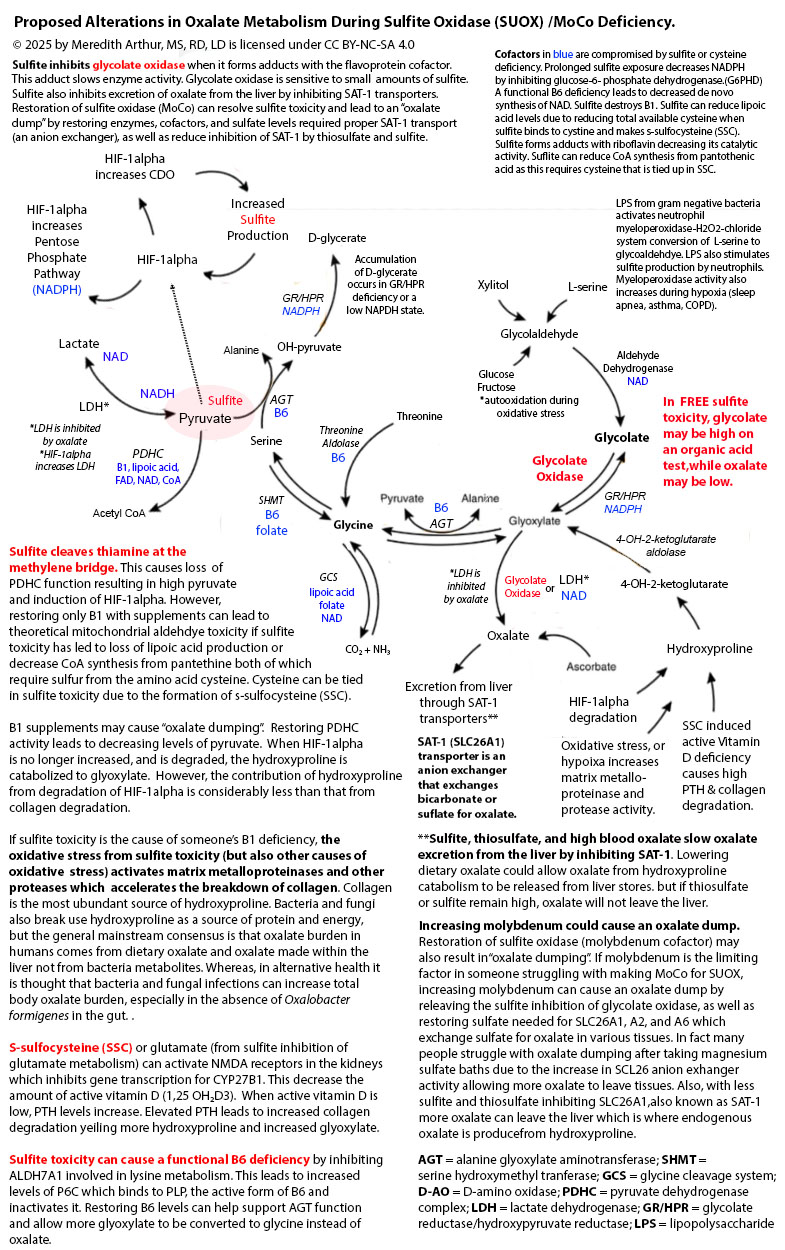
Resolution of Hyperoxaluria Due to Sulfite Toxicity?! Good thing?

Zoey’s suddenly “cured” of hyperoxaluria as well as hyperuricemia. Is this a good thing? I think not. She has elevated glycolate levels, but low oxalate levels on her organic acid test, and her 24-hour urine oxalate levels are below the standard for someone her age as well as her urinary sulfate levels. I suspect worsening sulfite toxicity as the cause of her decreased glycolate to oxidase conversion. This isn’t a sign of improvement. It’s a sign of severe dysfunction. See the diagram below. Glycolate oxidase is inhibited by sulfite.

Zoey struggles with sleep apnea. Despite our best efforts, she rarely keeps her mask on for more than 2-3 hours per night. This means that during the night, her body increases gene transcription for HIF-1alpha in response to hypoxia. In a hypoxia state, HIF-1alpha goes to the nucleus and alters metabolism, including increasing the enzyme cysteine dioxygenase. This leads to a downstream increase in sulfite production which puts a burden on sulfite oxidase, the enzyme that metabolizes sulfite to sulfate. In addition, sleep apnea increases the activity of the enzyme xanthine oxidase. This used to be the cause of Zoey’s high uric acid levels. Xanthine oxidase uses molybdenum cofactor. Overall, sleep apnea sets the stage for Jenny Jones, PhD’s “Moco Steal” by increasing the need for more molybdenum for xanthine oxidase as well as increasing the total amount of sulfite produced by increasing CDO activity.

When the MoCo Steal from sleep apnea became extreme to the point that there wasn’t adequate molybdenum cofactor for sulfite oxidase, the sudden surge in sulfite caused a functional B6 deficiency through inhibition of ALDH7A1 resulting in a build-up of P6C. This led to decreased activity of cystathionine-beta synthase and cystathionine-gamma lyase. These two enzymes provide a significant amount of hydrogen sulfide that turns off the HIF-1alpha gene transcription. As hydrogen sulfide production decreased in Zoey’s enterocytes, she developed small intestinal bacteria overgrowth to compensate for the decrease in H2S (Greg Nigh has a theory that we grow sulfur metabolizing bacteria to provide our bodies what we need).

With the excess hydrogen sulfide in her gut, and a very oxalate restricted diet due to a history of hyperoxaluria, Zoey’s total molybdenum absorption decreased significantly due to sulfur can bind to molybdenum and when complexed with dietary copper, form a molybdenum-copper-sulfate complex that is unabsorbable. This perpetuated the problem. Over a year, her body became severely molybdenum cofactor deficient to the point that sulfite in her liver inhibited glycolate oxidase resulting in markedly high glycolate levels on her organic acids, but within range values of oxalate and below level oxalate on her 24-hour urine test.

Above you can see that Zoey’s 24-hour calcium levels have come down. She actually has decreased hypercalcemia because overall, she has improved from a vitamin A standpoint. Her serum vitamin A has dropped to 49 ug/dl which decreases osteoclasts being aggravated and breaking down bone.

Her 24 hour citrate levels have plummeted further. This is because sulfite can bind to pyruvate and prevent pyruvate metabolism to acetyl CoA. In addition, sulfite can damage all of the cofactors needed for the pyruvate dehydrogenase complex (B1, FAD, NAD, lipoic acid, and CoA). In addition, if sulfite is bound to pyruvate, it can’t be made into oxaloacetate. This leads to decreased overall levels of citrate.

Zoey’s urinary pH is quite neutral, but this is of concern to me because her blood chemistry panels over the past two years have shown hyperchloremic normal anion gap acidosis. This is consistent with renal tubular acidosis OR the actions of glutamate/s-sulfocysteine on NMDA in the kidney and activation of the sodium exchanger (ENaC). I have seen this hyperchloremic normal anion gap acidosis in many people who have suspected sulfite oxidase/moco deficiency. Activation of the ENaC results in uptake of sodium and chloride and wasting of potassium (sodium and chloride in urine below the reference range). Zoey’s urinary potassium is quite low, but her blood potassium is also low on blood draws. She has become potassium deficient and so her body is attempting to retain as much potassium as possible. During this 24-hour urine test she was getting 1000 mg of potassium citrate and 350 mg of magnesium citrate.

Zoey’s low phosphorous level is of a concern due to it may indicate intestinal malabsorption. She has a high risk for Crohn’s disease due to MBD5 deletion can increase the mRNA expression of FOLH1, that is higher in individuals with Crohn’s. The drop in her urinary sulfate below normal is consistent with sulfite oxidase deficiency. I suspect her levels are even lower because I give her magnesium sulfate foot baths every other day. The drop in her creatinine and urinary urea nitrogen indicated struggles with creatinine production (functional B6 deficiency and/or methylation decreased due to sulfite binding to B12, inhibiting betaine production, and oxidative stress damaging 5-methylfolate). Her low urinary urea nitrogen indicates a probable decrease in ornithine production needed for running the urea cycle as this is a byproduct of creatine production as well as can be made from proline but requires vitamin B6.

As you can see above, overall, Zoey is struggling with sulfite toxicity. I think that since birth (she had hypoxia in the womb due to placental abruption) Zoey has been stuck in the HIF-1alpha pathway to varying degrees her whole life. We are working on a therapeutic plan to deal with this constant, chronic uptick in sulfite production as well as strategic avoidance of sulfur foods at the time of taking mozyme forte.

References:

  1. Ghanem, Mahmoud. On the mechanistic roles of the protein positive charge close to the N(1)flavin locus in choline oxidase.
  2. Meier, Sebastian & Solodovnikova, Natalia & Jensen, Pernille & Wendland, Jürgen. (2012). Sulfite Action in Glycolytic Inhibition: In Vivo Real-Time Observation by Hyperpolarized 13C NMR Spectroscopy. Chembiochem : a European journal of chemical biology. 13. 2265-9. 10.1002/cbic.201200450.
  3. Oxidative stress from sulfite toxicity leads to loss of 5-methylfolate leading to burden on folate metabolism. Sulfite can bind to BH2 causing loss of BH4. Sulfite can lead to low levels of PLP. Pyridoxal 5’‐phosphate in cerebrospinal fluid; factors affecting concentration – Footitt – 2011 – Journal of Inherited Metabolic Disease – Wiley Online Library
  4. Glycolate Oxidase Is a Safe and Efficient Target for Substrate Reduction Therapy in a Mouse Model of Primary Hyperoxaluria Type I – ScienceDirect